navfusion
Engineering-grade modular sensor fusion for 3D navigation.
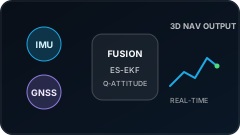
A real-time-first, event-driven fusion engine designed for robotics and autonomy systems that need stable pose estimation under delayed, missing, and noisy measurements.
Status: v0.1.0-alpha
What it solves
navfusion targets one of the highest-cost autonomy failures: navigation stacks that degrade sharply when sensor timing or quality departs from nominal conditions. It provides a modular fusion backbone built for engineering teams that need predictable behavior, diagnosable failures, and reproducible validation outputs.
- Maintains stable state estimation during GNSS dropouts and delayed measurement bursts.
- Reduces integration friction for mixed-rate, asynchronous sensor pipelines.
- Supports recruiter-facing and safety review narratives with concrete diagnostics.
Engineering highlights
- Real-time-first event-driven fusion engine.
- Error-state EKF with quaternion attitude representation.
- IMU propagation plus GNSS position/velocity fusion.
- Asynchronous sensors with bounded out-of-order handling.
- Innovation gating and robust diagnostics for measurement integrity.
- Modular architecture for extension toward additional sensor modalities.
Reliability and validation
Reliability is treated as a first-class output, not a side effect. Validation pipelines are designed to expose estimator inconsistency early and to preserve reproducibility across benchmark runs.
- NIS/NEES consistency checks integrated in CI.
- Benchmark artifacts captured for post-run review and hiring-panel walkthroughs.
- Reproducible docs and demo outputs tied to versioned code paths.
- Diagnostics centered on innovation behavior and gate decisions.
Demo scenarios
- GNSS dropout handling.
- Out-of-order and delayed GNSS robustness.
- GNSS outlier rejection with gating.
Links
Repo: github.com/leo-01000111/navfusion
Docs: www.leongorecki.eu/navfusion/
Next steps (planned)
Planned path includes an Unscented Kalman Filter (UKF) branch for stronger nonlinear handling, while preserving current benchmarking discipline and consistency diagnostics for fair A/B evaluation.